
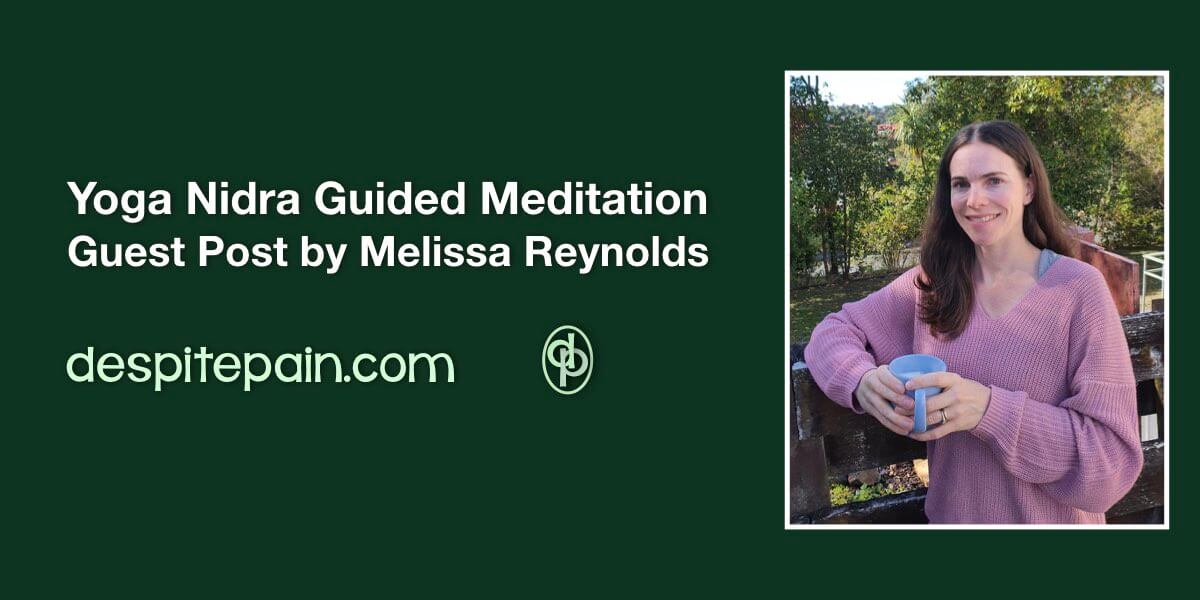
This month, I am extremely happy to share a guest post from another chronic illness blogger. Melissa Reynolds from melissavsfibromyalgia.com is sharing one of her favourite self-care tools, Yoga Nidra.
Melissa is a yoga and meditation teacher, mama to four small boys, author of two books and founder of Melissa vs Fibromyalgia. She’s passionate about sharing her journey to help make others’ lives easier.
Yoga Nidra – My Favourite Self-Care Tool by Melissa Reynolds
I am really excited to be able to share my absolute favourite tool for self-care with you.
As a busy person managing chronic pain and fatigue, I’m rather fond of efficiency. It’s really handy that my favourite self-care tool doubles as help for symptoms.
Yoga Nidra guided meditation is also known as “yogic sleep”. It’s a specific style of guided meditation that takes us through a process in which our brain wave patterns mimic the deeper sleep stages. Those restorative stages of sleep are what we tend to miss out on with fibromyalgia.
I have four children, under eight years old. The youngest has just turned one. For his entire first year we woke every 1-2 hours. He had reflux issues which put sleep learning far behind. We still wake frequently through the night.
The only way I have managed is through my afternoon yoga nidra rest. Each day after lunch, I send my elder two for quiet time (if they are home), put the three-year-old and baby down for naps, and I take a meditation break. Sometimes I only manage 15 minutes because the baby doesn’t want to take a decent rest. But the beauty is that there are many options. From 10 minutes through to more than an hour. There are also many different purposes (i.e. for sleep or pain). I tend to do 20-30 minute sessions. But a 40-minute practice is a treat.
It hasn’t been easy keeping space for this self-care habit. There are many other things that need to be done. However, it helps me to continue functioning, helps me with my symptoms and I just love it. Self-care is one of the first things to go for people who have a lot on – but those are the people who need it most! There is research around the benefits of self-care – and it is important for general health and wellbeing.
How I Started Meditating
I started meditating purely because I was miserable, exhausted and desperately needed some rest when my first baby was small. My chronic pain and fatigue flared up from pregnancy and delivery and having a tiny baby who didn’t sleep much.
I began with a 20-minute yoga nidra guided meditation and experienced rest for my body and mind in a way I couldn’t remember ever achieving (I have had chronic pain, fatigue and insomnia since I was a teenager). I was hooked!
For the past seven years I have meditated daily, researched, trained and basically become very passionate about using mindfulness and meditation for the chronics. As a side-benefit I found my anxiety levels have plummeted. I didn’t even realise anxiety was a problem for me until the volume turned right down.
It has helped me with:
- Pain
- Fatigue
- Insomnia (it is easier to get to sleep, stay asleep and get back to sleep)
- Anxiety
- Rest
- Connecting with my body (getting past the big sensations to see they are not my body)
It is a natural option and one of the most prominent parts of my whole-of-life treatment plan.
The Features of Yoga Nidra Meditation and How to Use it
Here’s what I think is one of the best features of yoga nidra – I do it in my bed with my heating pad on. You can also do it in a comfortable chair or on your yoga mat after a class. I have been known to do it in my car (when my first son was small and I needed a rest after work before picking him up).
In addition to being super relaxing, reducing my fatigue and pain for the afternoon and calming my central nervous system, it provides me something nothing else does. For those first few minutes after I complete a meditation my body is entirely relaxed. I float in a space of no sensation.
If you’ve experienced chronic pain for any amount of time, you will know what a pleasure that is.
I also do yoga nidra during intense flares, especially migraine flares that send me to bed. It is much more restful than lying there in extreme pain, unable to sleep.
Some ideas for when you could try it:
- First thing in the morning
- As a rest during the day
- Right after work
- Before bed
- During the night (painsomnia!)
- On a plane or train
- During a flare
It’s the first thing I suggest when I’m working with new students.
For more about what it is, some research and a free class, check out this post – Yoga Nidra for fibromyalgia
I tend to suggest people try it before bombarding them with all of the research and information. I am so in love with it that I’ve completed my 200-hour meditation teacher training and three extra Yoga Nidra specific courses.
It’s fascinating to me, especially how it works on helping us to activate the parasympathetic nervous system (rest and digest mode). I believe this is an important part of managing chronic illness well. But before this turns into a thesis on yoga nidra, the central nervous system and chronic pain, I’ll simply offer you this free class and say thanks for reading this post! https://payhip.com/b/luOSn

Self-care is so important for everyone, but it’s especially important when you’re living with pain or a chronic illness. I use several different self-care tools like breathing and distractions but I’ve never used Yoga Nidra. After reading Melissa’s post, I think I’ll need to give it a try.
Thank you Melissa for sharing your favourite self-care tool with my readers. Yoga Nidra sounds like it could be so helpful for many people.
I can’t keep up with what I do and look after myself with health problems, so it boggles my mind how Melissa copes with four kids under 8 alongside everything else. Amazing, and I’m glad she’s found something to be beneficial for her. I’ve never tried Yoga Nidra either, Liz, but I agree, it sounds tempting when you hear how much it has helped someone!
Thanks Melissa for sharing this – it could be very helpful for others to give it a try because we need all the help we can get for self-care and symptom management. xx
Oh Caz, I know!! I don’t know how she manages. Yoga Nidra really does sound helpful. I think it would be worth trying.
Thank you for sharing this post by Melissa. I absolutely love Yoga too. I started doing restorative yoga most days right before bed and it definitely helps me sleep and made a massive reduction in the dizziness and shakiness I experience. I’ve never heard of or tried Yoga Nidra but it sounds great, I’ll have to check out the free class. I especially love that it can be done anywhere, sat in your car and out and about, which is such a brilliant tool.