
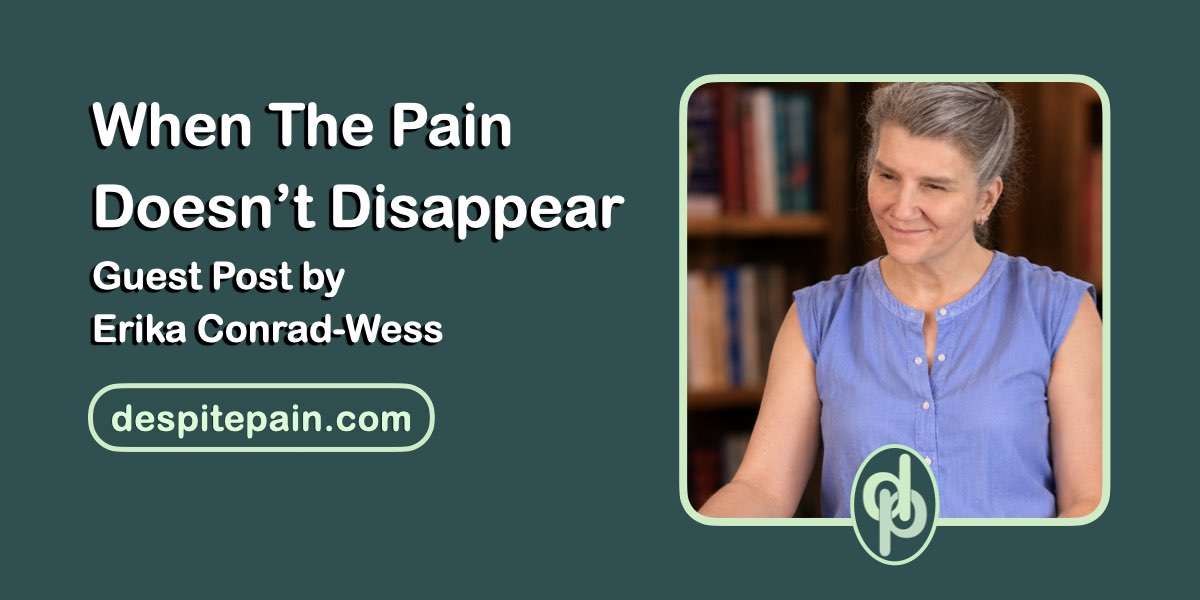
Living with pain that doesn’t want to disappear is never easy, but somehow, we have to find a way to get through each day. In today’s post, I am thrilled to share an article by an old friend, Erika Conrad-Wess, who talks about her journey with trigeminal neuralgia and how she has learned to live alongside her pain.
I have known Erika for many years through trigeminal neuralgia awareness and support groups. She has been an amazing advocate, using her knowledge and experience to help other patients. Recently, Erika published her book, NERVE, in which she writes about her diagnosis, failed procedures, and the toll of living with pain that doesn’t disappear.

When The Pain Doesn’t Disappear — by Erika Conrad-Wess
Like many of you, I am a chronic pain warrior.
In 2005, I was diagnosed with trigeminal neuralgia (TN), a chronic facial pain condition. In 2014, I sustained permanent nerve damage during a surgery intended to treat it, resulting in a different neuropathic pain condition called Anesthesia Dolorosa. All told, I have lived with chronic facial pain for 21 years.
I spent most of those years fully tuned in to “patient-ing”: researching new doctors and treatments, scheduling consultations, arriving with hope, enduring another procedure or medication that failed, swallowing the disappointment, regrouping, and trying again. Inertia carried me from one potential remedy to the next, emotionally suspended between high hopes and hopes collapsed.
My medical résumé grew year by year. I underwent brain surgeries and increasingly extraordinary treatments including a six-day, medically induced ketamine coma and implantation of an electrical stimulator inside my skull. I kept pursuing relief because I knew no other way of living with my diagnosis.
My Hope For Painlessness Became Captivity
For the first ten years, my hope was for painlessness and a return to my “real life.” It wasn’t foolish to keep looking—there were things worth trying. Over time, though, my pursuit of painlessness became its own kind of captivity.
In 2014, I had my second microvascular decompression (MVD), a brain surgery to relieve pressure on the affected cranial nerves. When my facial pain morphed from the sudden zaps and background drone of TN to the 24/7 burning, pulling pain of nerve damage, I had to confront the likelihood that the pain would always be with me.
I won’t sugarcoat it. Letting go of the imagined future in which pain lived in the rearview mirror was terribly painful. But despite the heartbreak, there was also liberation. I could still seek sensible treatment. I could still wish the pain were gone. I could still have terrible days. But I could also lean into the facts that this is my life and today counts.
Acceptance Isn’t Pretending Pain Doesn’t Matter
Acceptance isn’t gratitude for suffering or pretending pain doesn’t matter. For me, it meant pain could remain an important fact about my life without being its core organizing principle. I built a habit of making plans even though pain might interfere—working around reality rather than always waiting for an ideal moment. I bought concert tickets to shows we wanted to see, knowing I might not be able to attend. I missed quite a few—but I attended at least as many as I missed, and that wouldn’t have happened if I’d planned with pain in mind.
Another big step for me was publicly allowing pleasure to coexist with pain. I stopped caring how I would be judged and began sharing the good days and the bad on my socials. Eventually, my Facebook account reflected the whole picture: joy when I was up to finding it, and hardship when pain ruined an outing, an event, or an entire day. I gave myself permission to be a whole person online and hoped that my posts would encourage others to do the same. My message was always that a meaningful life and a painful life are not mutually exclusive.

There is an After Even Though Pain Doesn’t Disappear
As time went on, I realized that I had at least a book’s worth of experiences and earned wisdom in me—and that sharing it mattered. But when I envisioned what it would look like, I kept running into one inconvenient fact: there was no tidy ending to my story. I had a character arc, a plot, and a thesis, but how could I write a satisfying story without a resolution? The answer came to me when I realized that the most important story is what happened when my pain didn’t disappear.
I wanted other people living inside this relentless cycle to know that there can be an “after” even when there isn’t a medical resolution.
I also wanted clinicians, families, and others to understand what happens psychologically when someone spends years moving through healthcare as a chronic-pain patient: the hope, dependency, fear, medical trauma, and constant pressure to keep searching.
Try to Seize Happiness When You Can
To anyone now treading the same water, waiting for your life to begin again, you don’t have to give up hope to let go of the ideas that are holding you back. Your life isn’t on hold. It’s happening now, so seize happiness and pleasure whenever you can. If you felt horrible this morning but were up for a movie this evening, buy the ticket and enjoy yourself without fear of judgment. If someone judges you for having a good evening after a terrible morning, let them. You do not owe anyone consistent suffering.
Of course, there are things pain has taken from me, and some of those losses are permanent. That is real. But whatever remains belongs to me now, not to some hypothetical future version of me who finally gets well.
I still have constant nerve pain. It came and went in the early years, but it hasn’t relented for a single day in the last twelve. I also have a life to live. Time doesn’t stand still just because I do.
It took me a long time to understand that real pain and a full life could exist together.
I hope you figure it out, too.

A Little More About Erika, and Her Memoir NERVE
Erika Conrad-Wess is a writer whose work is shaped by more than two decades of living with trigeminal neuralgia and anesthesia dolorosa, a rare and devastating neuropathic facial pain condition. With fierce honesty and dry wit, she writes for anyone who has felt disbelieved, dismissed, or forced to rebuild life when a cure is not possible. NERVE: A Memoir of Chronic Pain, Medical Trauma, and Surviving the Healthcare System is her debut memoir. Buy it at Amazon or wherever books are sold online.
Paperback, hardcover, and Kindle editions — USA
Paperback, hardcover, Kindle, and large print editions — UK
✼✼✼
A huge thank you to Erika for sharing this post for my readers.
Thank you so much for reading.
If this post resonated with you, I’d love to hear your thoughts in the comments.
And feel free to share it with your friends or support groups.
Take care,
Liz.
Please subscribe and follow me on social media to stay updated on my latest posts!
Much love to you and your readers, Liz! ❤️
Thank you, Erika.