
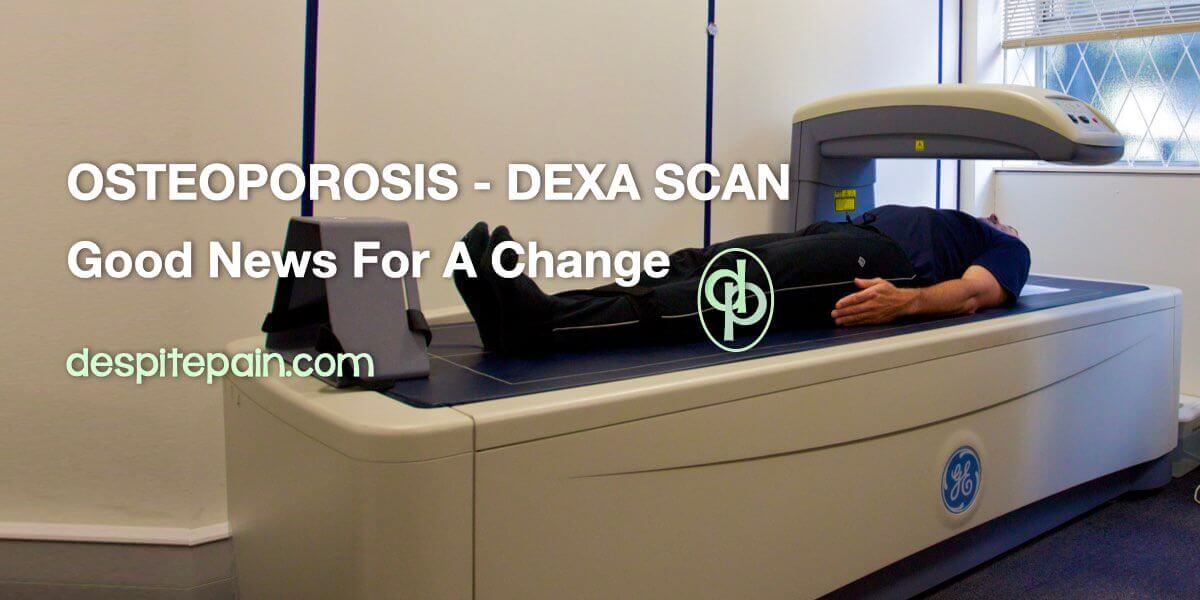
A couple of weeks ago, I had to go to the hospital for a DEXA scan to check on my osteoporosis. I have received the result and for a change, it is good news.
The DEXA scan showed that my osteoporosis isn’t quite as bad as it was. It’s nice to open a letter containing some good news.
What is Osteoporosis and What’s a DEXA Scan?
Osteoporosis means that the bones (osteo) are porous (porosis). Bones become more fragile and might break or fracture easily. A fall that might normally cause a bruise might cause a broken bone instead. A cough or a sneeze could result in a broken rib. Even turning in bed or bending down to tie shoe laces could cause a fracture. Osteoporosis in itself isn’t painful but, obviously, broken bones are very painful.
Everyone loses some bone density as they age, but there are some risk factors which can mean people might develop osteoporosis at an earlier age.
Those include:
- Genes can often determine a person’s structure and bone strength.
- Being a woman – after going through the menopause, oestrogen levels decrease. Oestrogen helps to keep bones strong.
- Some medications such as steroids, anticonvulsants, breast cancer and prostate cancer treatments.
- Some medical conditions such as early menopause, eating disorders, rheumatoid arthritis, and hyperthyroidism.
- Health conditions that affect the absorption of food such as coeliac disease or crohn’s disease.
- Having a low body weight.
- Gastrointestinal surgery often means that the stomach cannot absorb nutrients sufficiently.
- Smoking.
- Drinking a lot of alcohol.
- Being unable to exercise is also a problem as exercise can help to strengthen bones.
If a patient has broken a bone easily or if they are thought to be at risk, their doctor might want to check if they have osteoporosis.
DEXA Scan (dual energy X-ray absorptiometry)
In the UK, a DEXA scan is normally used to examine bone density to determine if a patient has osteoporosis.
Having a DEXA scan is fairly quick and painless. There are no tunnels or injections involved. You need to lie on your back for about 15 minutes or so while a radiographer operates the scanning machine. A large scanning arm passes over various parts of your body (normally the centre of the spine, hip and femoral neck) to take images of the bones.

Several factors are used to work out a patient’s bone density score. You can learn more about how the scores are calculated here. The scores show whether a patient has normal bone density, osteopenia or osteoporosis.
1 to -1 means that bone density is normal
-1 to -2.5 means that bone density is slightly below normal. This is called osteopenia.
-2.5 and under means that the bone density is low and classed as osteoporosis.
Treatment Options for Osteoporosis
There are several medicine-based treatment options for osteoporosis.
Supplements
Doctors normally prescribe or recommend calcium and vitamin D supplements to anyone diagnosed with either osteoporosis or osteopenia.
Bisphosphonates
Bisphosphonates slow the rate bones break down.
The following drugs are examples of bisphosphonates.
- alendronic acid
- ibandronic acid
- risedronic acid
- zoledronic acid
Some of these are prescribed in tablet form, some are injections and some are given as infusions.
Selective Oestrogen Receptor Modulators (SERMs)
SERMs have a similar effect on bone as oestrogen and help to maintain bone density thereby reducing the risk of fractures (especially on the spine).
Raloxifene is the only type of SERM available for treating osteoporosis and is taken in tablet form.
Parathyroid Hormone
Parathyroid hormone regulates the amount of calcium in bones and is created naturally in our bodies.
Other osteoporosis medication slows down the rate of bone thinning but parathyroid hormone can increase bone density. But it’s only used if a patient’s bone density score is very low and other treatments haven’t worked.
Parathyroid treatment such as teriparatide is given by injection.
Antibody Treatment
Antibody treatments can help to strengthen bones.
Denosumab is one of those antibody treatments. It slows down the rate that your bones break down and comes as a six-monthly injection.
Romosozumab is another antibody treatment. It is a new drug that could be used for some women with osteoporosis. Doctors might prescribe it if you are a post-menopausal woman who has broken a bone within the last two years and you are at a high risk of having further breaks. Romosozaumab slows down the rate of bone loss and speeds up the cells that build up bone.
Preventing Osteoporosis and Looking After Bones
It’s a true saying – prevention is better than cure. And, in some cases, osteoporosis can be prevented. If you have osteopenia, it could worsen and become osteoporosis, so it’s especially important to take measures to try to prevent that from happening.
If you already have osteoporosis, it is important to try to prevent it from worsening. Even if you are taking prescribed medications, there are probably extra measures you can take.
Diet
Diet is a very important factor in preventing osteoporosis. A balanced diet is important but calcium and vitamin D are crucial for bone health.
You can find calcium in dairy products, green leafy vegetables, dried fruit and soybeans. Some foods are fortified with added calcium, so look out for those too.
Vitamin D is often known as the sunshine vitamin. This is because the body creates vitamin D from direct sunlight on the skin. The problem with living in the UK, is that we don’t tend to see a lot of sunlight for several months of the year.
Some foods do contain Vitamine D though. You can be find it in oily fish, red meat, liver and egg yolks. And, like calcium, some foods are fortified with vitamin D.
Although calcium and vitamin D can be found naturally, it is a good idea to also take a supplement.
Hormone Replacement Therapy (HRT)
Oestrogen helps to keep bones strong so after the menopause, there is no oestrogen to do that. This is why osteoporosis is more common in post-menopausal women. HRT can replace oestrogen and might help to maintain bone health.
Smoking and Drinking
Since smoking and drinking a lot of alcohol are considered as osteoporosis risk factors, it’s a good idea to stop or at least try to cut down.
Exercise
Any exercise is good, but according to the NHS, weight-bearing exercise and resistance exercise can improve bone density and also help prevent osteoporosis.
This page on the Royal Osteoporosis Society website has excellent advice about exercise.
Exercise might not always possible though and it can be a minefield trying to figure out what’s best for you individually. Therefore, it’s always good to get advice from your GP, osteoporosis specialist or a qualified physiotherapist.
Preventing Breaks
Accidents happen, we all know that. And if you have osteoporosis, a fracture can happen for no apparent reason sometimes. Taking extra care, especially if you are at risk is important.
- If you have balance or coordination issues, always let your doctor know. They should investigate to find out why.
- Know your alcohol limits – avoid drinking too much if it makes you unsteady.
- Use a walking aid if you need one (indoors and outdoors).
- Fit handrails on outside steps.
- In your bathroom use grab rails and put a non-slip mat into your bath or shower to prevent falls.
- Wear non-slip shoes, boots or slippers.
- Avoid walking outside in icy conditions but if you really need to, always wear shoes or boots with good grips. You could put ice grips or crampons onto your shoes if necessary.
- If you have a cough or you feel a sneeze coming, try to sit straight and hold a pillow tight against your ribs.

My Story – A DEXA Scan First Showed I Had Osteoporosis in My Early Forties
Doctors first diagnosed me with osteoporosis approximately 15 years ago.
I started going through an early menopause in my mid to late thirties. I knew that osteoporosis was a risk because of this. But I had other risk factors too.
- Until my mid-forties, I was a little bit underweight.
- I couldn’t really exercise due to my pain.
- I had given up dairy food in an attempt to help my chronic migraines.
- Although I didn’t know it, at that time, I had coeliac disease which is another risk factor.
So, since I knew I was at risk of having osteoporosis, I repeatedly asked my GPs about getting a DEXA scan. Three GPs in the practice refused to send me for a scan. One GP, a man in his sixties, actually told me I was much too young to “be worrying about something like that.”
He was wrong. I wasn’t too young to worry about it.
We moved house when I was forty, which meant registering with a new GP. My new GP asked if I had any concerns and I mentioned osteoporosis. Her first words were, “Have you had a DEXA scan?” She seemed shocked that I hadn’t and immediately sent a referral for a scan.
A few months later, the DEXA scan confirmed that I did have osteoporosis.
My Osteoporosis Treatment
Initially, the doctor prescribed me with a calcium and Vitamin D supplement and one of the bisphosphonate medications, Alendronic Acid. I had to take it once a week, first thing in the morning on an empty stomach.
In 2016, the osteoporosis specialist changed my medication. I had to start getting an annual infusion of another bisphosphonate drug, Zolendronic Acid along with the calcium and vitamin D supplements.
I get a DEXA scan every three years but for the first time, this latest scan has shown an improvement in my bone density. Unfortunately, I do still have osteoporosis, but my scores have improved. Some of them improved significantly. The consultant suggests having one more infusion this year and then having a break from it for the next three years. (I will still have to take the calcium and vitamin D supplements.) I will then have another DEXA scan after which the consultant will decide on further treatment.
My Coeliac Disease Diagnosis Possibly Helped Improve My Osteoporosis
The bisphosphonates drugs that I have been using for the last 15 years have helped to slow down the rate that my bones break down. But I think something else has played a part in improving my osteoporosis. I think that my gluten-free diet due to having coeliac disease has played a huge role.
A doctor diagnosed me with coeliac disease in 2017 but told me that I probably had coeliac disease for many years without knowing it.
Coeliac disease means that your body doesn’t absorb nutrients. So my body was not absorbing calcium and vitamin D which bones need. Once I learned that I had coeliac disease, I removed gluten from my diet. I have now been on a strict gluten-free diet for almost five years. This has allowed my stomach to heal and start absorbing nutrients again.
I think this, along with the medication, has made a difference to my bone health. DEXA scans have never shown an improvement in my osteoporosis until now. Having coeliac disease is a bit annoying at times but being gluten-free is obviously good for my bones.
That’s good that there was improvement shown in the results. I have learnt something new because I always though once osteoporosis has been diagnosed, I always thought it would be maintaining the current bone density, or finding it getting worse. So its good to see that some possible improvement can be made too. No matter how small the result.
It was a pleasant surprise for me too, Liz. Thank you for commenting.
I started two drafts probably years ago now (yikes!), one on supporting bone health and one on osteopenia and osteoporosis specifically. Never did get around to doing those posts either and don’t really need to now even though you’ve inspired me because you’ve got it all in your fab post! It’s such an important topic. I don’t think patients are often given much information on their diagnosis, most not even given their results, not really informed about the medication they’re being recommended or given any choice of meds either. I hadn’t even realised until reading this that there are antibody treatments for bone strengthening, wow!
I am so, so sorry you had such ignorant asses for doctors at first. And I’m so bloody angry you were told you were too young! Grrrr. I’m glad you kept pushing and raising your concern, but I’m sorry it turned out your curiosity was warranted.
I was diagnosed osteopenia before I was 30 (28 years old I think). I wasn’t told my result and only found out more recently from medical records that it was like 0.01 or 0.1 off from osteoporosis. Apparently there are no treatments for those pre-menopause. I was given no further help or advice, nothing other than get more calcium. But at least at that point I found my Vit D levels, which nobody had ever checked until then, were pretty much non-existent so that could be corrected. After diagnosis I think you should get scans every 5 years in England but it has been 6+ years now and I’ve not heard a peep. Ditto for my mum, who was on alednronic acid for years like you started on. Do you mind me asking why that was changed? So instead of a once a week tablet, you had an infusion once a year of a new bisphosphonate drug and also took supplements? I’d never even heard of an infusion being done for osteoporosis. I’ve learned a lot today!
I really do hope the treatment and supplements and changes to diet too can help your bones, Liz. It seems it can take a lot of time for strengthening to happen and only a little bit at that based on my mum’s experience, but it will happen and any extra bit of strength is worth it.
Caz xx
Hi Caz,
I wasn’t really given much info about osteoporosis initially after being diagnosed. But after my previous GPs attitudes, I was just grateful to be taken seriously and be prescribed meds. Fast forward a number of years, my hospital made one of the rheumatologists an osteoporosis specialist and hired a specialist nurse too. I saw her a few times and I think she was the one who changed me from alendronic acic to the infusion. I don’t know why…I didn’t ask, but was happy to have the infusion rather than the weekly tablet. I have to get scans every three years. Surprisingly, there have been no delays with that or with getting the infusions. I imagine the supplements are for life. Does your Mum take them too?
Both you and your Mum should surely be getting scans done regularly. I know they don’t treat premenopausal woman. I have no idea why – surely, if osteoporosis is diagnosed, the earlier treatment starts, the better? It’s probably got something to do with those wonderful people at NICE on a cost saving exercise.
Thank you as always for your comment.
Take care, Liz x
Thanks so much for this Liz!
I was just diagnosed with osteoporosis 15 years after diagnosis of osteopenia (I believe family history and ovary removal at age 48) are the major contributing factors (and simply gender and age).
My dr says I’m at ‘low to moderate risk’ of fracture within 10 years. She offered medication but not necessarily definitively, focussing her discussion on diet & exercise (I don’t smoke or drink & have bmi of 26).
I’m increasing my exercise and starting to ensure I get 1200 mg calcium daily through my diet. I take vitamin d supplements.
I know the serious risk factors (jaw necrosis & femur fractures) for the meds are rare but they do exist. I’m wondering if I might hold off meds for a couple years & get a new scan then to see my DEXA numbers.
If I do go on meds I will definitely take a ‘drug holiday’ after 3-5 years as recommended by my doc.
Your thoughts?