
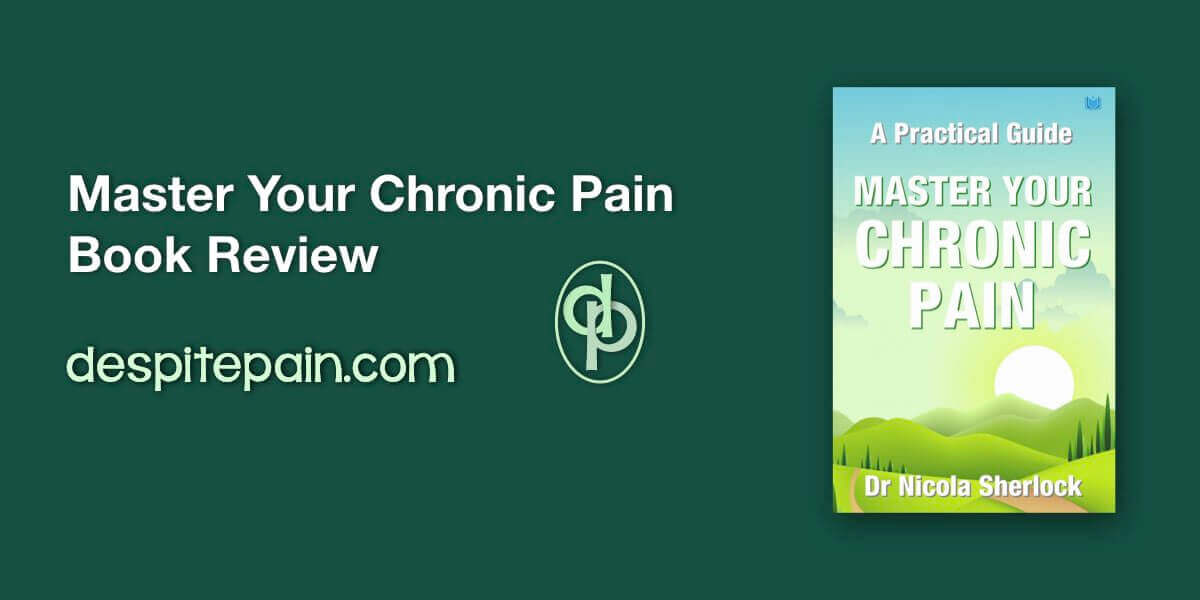
A few weeks ago, a book publisher contacted me to ask if I would be interested in writing a book review on my blog. The title of the book piqued my interest straight away, so I agreed. The book, “Master Your Chronic Pain”, by Dr Nicola Sherlock, sounded like it might be a helpful book for people in pain.
I have, in the past, been sent requests to review books or products which claim to cure chronic pain and I have turned them down. That’s because there isn’t a cure for chronic pain and I will never promote anything that makes false claims. However, the title of this book made me feel it was worth looking at. It didn’t sound as though the author was suggesting she could cure people’s pain. It sounded as though she was offering suggestions to help people live and cope with their pain better. And when I received the book, I was happy to find out that I was correct.
About the Author of Master Your Chronic Pain
Dr Nicola Sherlock is a consultant psychologist who has worked mostly within the NHS in the UK helping chronic pain patients for over twenty years. Nicola has used her knowledge and drawn on the experiences of some of her patients in order to write this book.
In the prologue, she explained that just after completing the book, she developed severe and prolonged sciatica. She was in extreme pain and had to put her own advice into practice.
I suffer from sciatica at times and understood how she must have been feeling. But, reading the prologue, I could sense her fear and panic in case her pain didn’t go away. Sensing that fear, made me realise that she really did understand the implications of living with chronic pain.

Master Your Chronic Pain
Nicola begins her book by explaining what chronic (persistent) pain is. Normally pain has a reason and that reason is to tell you that there is damage or to prevent further damage from occurring. But chronic pain is different. There’s no longer damage or risk of further damage but the brain feels the pain in the same way as if there was.
When some people hear that, they might say, ‘So that means the pain is in your head. It’s not real.’ But that’s not true. The pain is real. Very real and Nicola explains that several times in the book.
Nicola explains the difficulties of living with chronic pain – how it affects so much in life. She writes that she isn’t offering a cure. Instead, she is offering tools to help people manage their pain. She likened it to a DIY enthusiast having a toolbox containing only a hammer. A hammer on its own wouldn’t get them far. They need more tools. Chronic pain patients need lots of tools. Painkillers are often a necessary tool, but they can’t help on their own. This book can hopefully provide the reader with extra tools to add to their chronic pain toolbox.
Working Through the Chapters
Nicola Sherlock wants to help people cope with pain and she does so in an understanding and compassionate way. She is not condescending nor is she preaching or trying to tell patients that their pain is their fault. She’s not suggesting that people can just ‘think their pain away’. Nor is she making unrealistic and unachievable suggestions.
Her suggestions are doable but they won’t always come easily – they will take work and practice – but she explains them in clear and simple chapters.
Perhaps every chapter of the book isn’t relevant to everyone. For example, there are chapters about stress management, sleep and diet that some people might not feel relevant to them. However, Nicola suggests reading each one. I read every chapter and I did get something out of each one. She also suggests asking your close family or friends to read the book so that they can understand more and be supportive.
Focusing on Your Values
In Master Your Chronic Pain, Nicola sets out a few exercises for readers. One is to think about your values in life. She frequently reminds you to look back at those answers because ultimately, those values, those things that are most important to you, are what will spur you into working your way through the book.
Nicola gives advice on topics such as stress, mindfulness, pacing, relationships, sleep and breathing. But she also covers the subjects which I’m sure most of us dread – exercise and diet.
Those topics often make us become defensive but that’s because they’re normally discussed in an accusatory manner. Some people (including some doctors) make chronic pain patients feel guilty, lazy or greedy. They see a weight issue before they see the pain and, often, they make impossible suggestions about exercise.
But Nicola doesn’t accuse, make judgements or make unrealistic claims. She doesn’t blame her readers for not exercising or for having put on a few extra pounds. She understands why that has happened. But she tries to give tools to help, and she gives them with compassion. She doesn’t suggest that people go to an aerobics class three times a week and eat salads for breakfast, lunch and dinner. She talks about taking small steps to make a gradual change. Small changes can add up and those changes might lead to being able to cope with pain better as well as increasing your self-confidence and self-esteem.
Acceptance and Goals
At the end of the book, she talks about acceptance and goal setting. Acceptance of life with chronic pain is difficult. Many people struggle with that. I’ve written about this topic myself. Once you accept that you have to deal with chronic pain, you stop fighting against it. You start to listen to your body and do what will hopefully help. When she discusses goal setting, she talks about the importance of setting realistic and achievable goals. But she also mentions that we have to make allowances because chronic pain is so unpredictable.
Master Your Chronic Pain Could Give People Extra Tools
I think Master Your Chronic Pain is definitely worth reading. It doesn’t offer unbelievable or unrealistic solutions. It might help you to live a better life, despite your pain.
On a personal note, this past year, my pain has been pretty bad. I write about pain management tips on my blog but often forget to take my own advice. When I was reading the book, I took more notice. I am not sitting here pain-free but I didn’t expect to be and the book didn’t promise that. It’s a work in progress. I know that my pain won’t disappear but I also know that if I can cope with it better, life feels better.
We all wish that there was a simple answer which could rid us of our pain. But the sad truth is that there isn’t one. Pain medication might help to reduce pain but I personally don’t know any chronic pain sufferer who takes medication and gets total relief. That’s why we need other tools in our toolbox to help. And, this book, “Master Your Chronic Pain” might help to give you some extra tools.
Master Your Chronic Pain can be purchased directly from the publishing company and most book retailers. It’s also available on Amazon in either paperback or digital format here.
Thanks for the review. I purchased the book on Amazon as soon as I finished reading your post.
Thanks so much for reading. I hope you find the book helpful.
Really helpful review, thank you 🙂
Glad you enjoyed it. Thanks for reading.
The irony to have written a book for chronic pain patients after helping them as a psychologist for years, to then get severe sciatica herself straight afterwards. I hope her own experience with patients helped her when she needed it and that she could take her own good advice. I think knowing the suggestions and tips is one thing, putting them into practice is another. A lot of us likely struggle with that “physician heal thyself” conundrum sometimes.
You’ve covered the topics on diet and exercise so well, Liz. You’re right, they do tend to make us defensive because they’re so often used in an accusatory fashion. I like Nicola’s approach to it, like with the the importance of small steps and the focus on our values to keep us going.
I’d quite like to give this a read. Even if we say we know everything she’s already written, possibly because we give the same suggestions ourselves to others, it’s rather different to read it from someone else. When I went to a pain management psychologist, I didn’t really learn anything new about managing pain. But just in our chats, I started to feel like it was okay to pace, it was okay to be struggling, it’s okay to slow down. You get a feeling that someone understands, someone’s giving you permission, you’re not the only one going through something like this. Of course the benefit from those sessions was very short-lived for me but that’s why I like the idea of a book you can keep going back to whenever you need to.
Like you found with your pain being so bad the past year, when we need to take our own great advice the most is often when it’s the hardest to do just that. I’m so sorry for the pain you’re in. It breaks my heart knowing others suffer like this too, so it must be a hard job as a psychologist dealing with chronic pain patients for years. So much pain, and many do not get the help or support they need within their lives or the health service.
Brilliant review, Liz. Thank you for sharing this book with us! xxxx
Oh, I know. I really felt for her when I was reading the prologue. You and I both give out tips and advice often and we know it’s easier to give than to put into practice. I am glad she wrote about it because straight away I got the feeling that she understands what a life with chronic pain can be like for people.
There are a lot of books out there that give false hope or make ridiculous suggestions so I was a wee bit apprehensive before it arrived. But I’m glad I was given the opportunity to review it. I really did find this helpful and I will be picking it up again for those times when I need someone else to tell me what to do when I forget to listen to my own advice.
Thanks so much for your comment.
Thank you for sharing this book, I’d never heard of it before. I always prefer and gain more from books written by people who have experienced chronic pain and illness too as I can relate to them more and they provide more realistic advice. I love her suggestion to get family and friends reading the book too, having people around you who understand and are more supportive makes such a huge difference. I love how many different areas she covers, it sounds like there’s something for anyone to benefit from. Making these small changes in lots of different areas adds up to make a huge difference in the long term.
Yes, I liked her suggestion to let family and friends also read the book because very often, they don’t quite understand. She covered so many areas that, like you said, there’s something for everyone.
Thank you for commenting.