
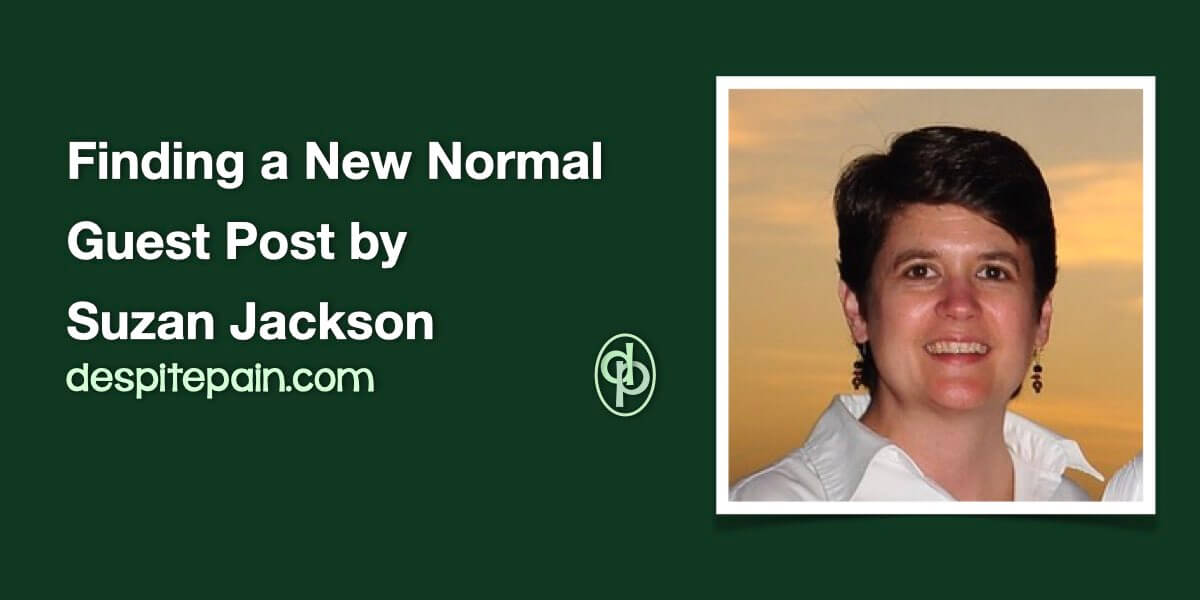
Today, I’m really happy to bring you a guest post from a fellow chronic illness blogger, Suzan Jackson. Suzan explains how she coped with life after developing ME/CFS (Chronic Fatigue Syndrome). Her life changed dramatically and this post explains her journey. She has also written a book entitled Finding a New Normal which could hopefully help people on a similar journey.
Suzan’s Story – Finding a New Normal
On March 2, 2002, my life split into Before and After. Prior to that, I was a healthy, active, happy woman of 37, living with my husband and our two young sons. I had had a wonderful, exciting career in engineering and consulting but had taken two years off to slow life down and spend more time with our kids. Then I woke up on March 2 with the worst sore throat of my life, flu-like aches from head to toe, and feeling completely exhausted. I thought I had the flu, but it never went away. I had days when I almost felt like my “old self,” but those were followed by times when I could barely get out of bed or off the couch, sometimes lasting weeks.
ME/CFS Diagnosis
A year of seeing specialists and getting hundreds of blood tests yielded no answers. Luckily, in March 2003, I stumbled onto a new primary care physician who immediately recognized my illness as ME/CFS (myalgic encephalomyelitis/chronic fatigue syndrome). With her help, I began trying treatments that each helped a little bit, though I struggled to accept that I now had a chronic illness with no known cure.
Then, the unthinkable happened. In 2004, both of our sons, just 6 and 10 at the time, also got ME/CFS (it has genetic roots and often runs in families). What followed was a dark time, but our family worked through it, became even closer, and learned a lot of lessons. Now, 20 years after I first became ill, I have both ME/CFS and Lyme disease but have found many treatments that each help a little bit, adding up to significant improvement. I still have limited energy, need a daily nap, and must carefully restrict my activity levels, but I can function fairly well most days. Our youngest son fully recovered after 10 years of milder illness, and our older son still has ME/CFS, plus three different tick infections, but like me, is doing well with multiple treatments.
Here are some of the most important lessons we learned about coping with chronic illness and pain, adapted from my book, Finding a New Normal: Living Your Best Life with Chronic Illness.
Acceptance
When I first became ill, I struggled with acceptance because it felt like giving up, but now I understand that in order to feel content with your life, it is essential. Acceptance doesn’t mean giving up hope of a better tomorrow. It means accepting where you are right now, today (even this hour), and listening to your body. If you are constantly fighting against your limits, then you are setting yourself up to keep relapsing (or crashing, as we say in ME/CFS). The best approach is a careful balance between acceptance and hope and holding onto the attitude that you are right where you need to be.
One coping mechanism that helps me is what I call a Plan B Day. This is useful when you have plans and things that “must” be done, but you wake up feeling awful. I learned long ago that ignoring my body and pushing through would only make me sicker, but I tend to be a fairly driven person! What helps me is to declare it a Plan B Day and take a few minutes to come up with my alternate plan. What on my list can be postponed? What can be delegated? What is truly necessary (liking picking up your kids from school!) and could you get help with that? Once you have briefly dealt with, postponed, cancelled, and delegated, then you can completely focus on caring for yourself.
Finding Joy
Acceptance allows you to have more peace in your life, and then you can focus on the small joys in every day. When you are first ill, it’s common to think only about all the things you can’t do, but even in very severe cases, there are still some simple pleasures you can enjoy. For me, my lifelong love of reading has greatly expanded since I became ill because I can still read (or listen to) wonderful books, and I love talking to others about what I read.
I started a Joy Journal to make myself more aware of the beauty and wonder all around me. Most days, the joys I wrote down were simple things, like the flavor of a favorite cup of herbal tea, lying out on our deck and listening to the birds, or enjoying a favorite book or TV show. A hug from my kids always made the list, and they used to lend me their favorite stuffed animals on my worst days!
Becoming aware of the simple joys in every day actually creates more joy. You learn to recognize and notice these moments of happiness, no matter how small. The same is true for gratitude. I post a daily #GratefulToday post across social media to help myself and others stop to think about what we’re grateful for.
Healthy Relationships
This is a tough one when you are chronically ill, so I devoted an entire section of my book to relationships. Your old relationships with friends or family may became strained because you feel like they don’t understand (and they probably don’t, unless they’ve been through it themselves), and they feel uncomfortable and don’t know what to say or do around you.
These are huge challenges and not always easily overcome, but it helps if you focus on what you can do. Most of us do not want pity but simply understanding, and what you say can play a large role in that. It also helps for you to reach out to family and old friends, rather than waiting to hear from them. They may be worried about disturbing you or not know what to say, so a quick, friendly text, e-mail, or phone call (if you’re up to it) can go a long way toward strengthening important relationships.
Happily, you can also form new relationships by finding others who are in a similar situation to you. These bonds can be very powerful, even if you don’t ever meet in person! Connecting in support groups (local or online), on social media, and on blogs like this one can be a powerful way to connect with others who “get it” and create new friendships.

These are just a few tips, based on 20 years of our own experience, plus that of others I have met locally and online. Living with chronic illness is not easy, but you can still lead a happy, peaceful, and fulfilling life.
How to Connect With Suzan
I would like to thank Suzan for sharing her insight into living with chronic illness.
If you’d like to connect with Suzan, please click on the following links:
- Blog – Live With CFS (You can sign up to be added to her e-mail list.)
- YouTube videos
- LinkedInd
And please check out Suzan’s book, Finding a New Normal.
Suzan! It’s lovely to see you featured here. But it does break my heart each time I read of someone who has that fairly distinct before/after in their life when hit with a chronic condition. It’s funny – it’s such a huge thing, life-changing, destructive, throws your whole life into disarray, and yet it seems medical professionals and other people expect we simply suck it up, get on with it, be grateful and keep going. It’s not that simple. I’m glad Suzan has written a book because I’m sure her experience will be priceless to those on their own journey.
Caz xx
Thanks for your kind words, Caz. You said it perfectly – this is such a huge shift and difficult journey, rarely understood by medical professionals. I’m so glad we patients have each other to lean on!
Sue
My Book: Finding a New Normal: Living Your Best Life with Chronic Illness
Thank you so much for the opportunity to write a guest post for your blog, Liz! I always enjoy your posts and am happy to be able to contribute to your wonderful content.
Sue
My Book: Finding a New Normal: Living Your Best Life with Chronic Illness
Thank you for providing a space for Suzan to share her journey and tips for others in similar positions. I agree with her tips, accepting where we currently are, learning to take things one day at a time and finding the joy in everyday life is so important and really helps me deal with everything better. One positive about chronic illness is it has made me appreciate the small things in everyday life that I completely took for granted and never appreciated before. Starting and ending my day with gratitude and listing what I’m thankful for or looking forward to really helps me start and end the day positively. I look forward to reading her book. Thank you again.
I so agree, Lucy! I end every day by posting a #GratefulToday post. You are right – it really helps, especially on the worst days, to remember you have things to be grateful for.
Sue
My Book: Finding a New Normal: Living Your Best Life with Chronic Illness
Found the tips helpful, thank you. I live in pain from multiple conditions, and I’ll apply these tips to my life. It’s hard to not focus on what I can’t do, but I’ll change my mindset to focus on what I CAN do. That’ll probably give me more peace than I have had.
That’s a really great point, Kimmie – it’s so much easier to get caught up in what we can’t do any more. I hope your attitude adjustment helps!
Sue
My Book: Finding a New Normal: Living Your Best Life with Chronic Illness